High-Velocity Oil Flushing Services for Pre-Commissioning Applications
PFP provides turnkey high-velocity oil flushing services to remove fabrication debris, achieve required cleanliness levels, and protect critical equipment before commissioning.
A newly fabricated hydraulic or lubrication system may appear to be clean and ready for operation. Inside the reservoir and piping components, however, contaminants often remain from manufacturing and installation.
Metal shavings, weld slag, grinding debris, scale, and other solid contaminants can be introduced while equipment is fabricated or assembled. If those contaminants are not removed before startup, the first circulation of oil can transport them directly into sensitive components. Pre-commissioning is one of the most important times to perform a high-velocity oil flush.
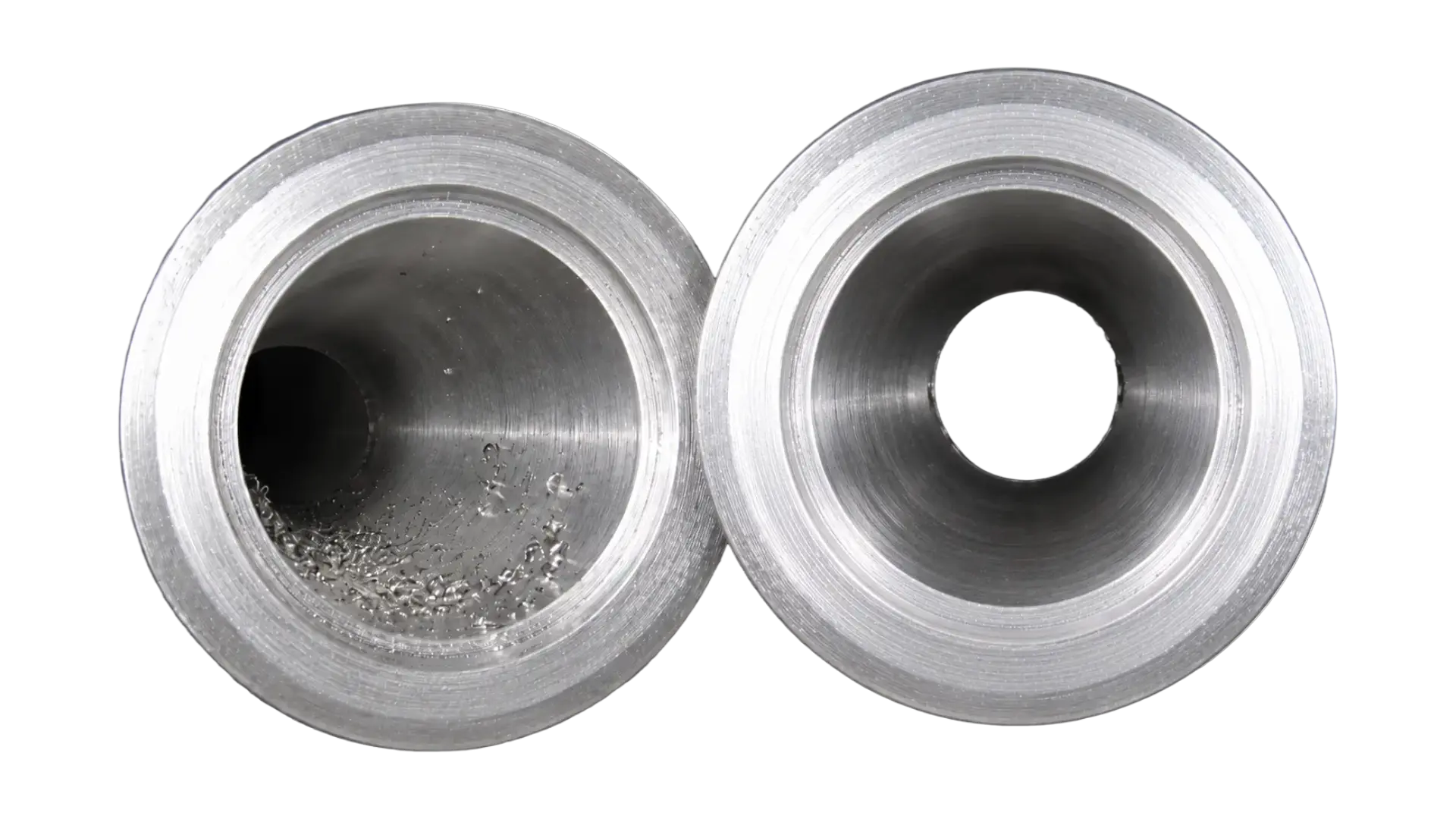
Pre-commissioning oil flushing removes loose fabrication and installation debris before a new or rebuilt industrial system enters normal operation. By establishing turbulent flow and continuously filtering the circulating oil, a properly designed flush helps the system reach its required cleanliness level before critical machinery is exposed to contamination.
What is Pre-Commissioning Oil Flushing?
Pre-commisioning oil flushing is a controlled cleaning process performed before an industrial hydraulic or lubrication system is placed into service.
The process typically uses temporary pumping, heating, filtration, hoses, and manifolds to circulate oil through the system at a higher velocity than normal operating flow. The objective is to dislodge loose particulate from internal surfaces and transport it to high-capacity filters for removal.
Pre-commissioning flushing is commonly performed on:
- Hydraulic systems
- Turbine lubrication systems
- Compressor lube oil systems
- Gearbox lubrication circuits
- New process piping
- Lube oil reservoirs
- Systems rebuilt after major maintenance
- Piping affected by equipment installation or modification
This procedure is considerably more involved than replacing the oil or running the permanent pump. A high-velocity flush is designed to clean the internal system before contamination reaches new bearings, pumps, valves, seals, and control components.
Why Can a New Industrial System Already be Contaminated?
A new system is not necessarily a clean system.
Contamination can be introduced during nearly every stage of fabrication and construction:
| Project Stage | Possible Contaminants |
| Pipe cutting & machining | Metal chips, shavigs, burrs, cutting residue |
| Welding | Scale, sclag, weld splatter, oxidation products |
| Grinding & finishing | Fine metallic particulate and abrasive debris |
| Storage & transportation | Dust, moisture, and corrosion products |
| Field installation | Dirt, fibers, sealant, construction debris |
| Initial oil filling | Particulate already present in new oil or transfer equipment |
Parker’s guidance for new hydraulic-system startup states that newly assembled systems can contain high levels of contamination introduced during assembly. Its recommended precautions include cleaning reservoirs, flushing hoses and piping, and filling the system with filtered (cleaned) oil.
Even components that were orginically cleaned can be contaminated again during storage, transportation, and final assembly.
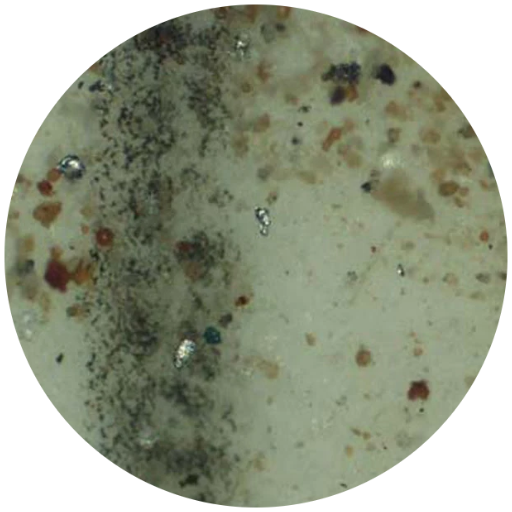
New Oil Does Not Mean Clean Systems
It is important to note that new oil does not guarantee a clean system. Oil delivered as “new” may still be unsuitable for direct introduction into a sensitive system without filtration. Pre-filtering the new oil is important, but it does not remove debris already trapped inside the piping. That requires the circulation & agitation capabilities of a properly designed flushing process.
Why Pre-Commissioning Cleanliness is Paramount
Contamination control directly affects system reliability.
Eaton states that more than 80% of hydraulic failures can be attributed to contaminated fluids. The company includes pumps, valves, hoses, and fittings among the components affected by contamination.
A contaminated startup can contribute significantly to:
- Premature component wear
- Sticking or malfunctioning valves
- Plugged filter elements
- Restricted lubricant flow
- Elevated particle counts
- Damage to pump clearances
- Delayed commissioning
- Failure to satisfy OEM cleanliness requirements
The risk can be particularly serious for systems containing servo valves, proportional valves, axial piston pumps, journal bearings, or other components with small clearances.
Starting the system before it has been properly cleaned may also spread localized contamination through the entire circuit. Debris originally left in one pipe section can be carried into reservoirs, coolers, manifolds, bearings, and control components.
The result may be a new system that begins its service life with abnormal wear already underway.
How Turbulent Flow Cleans Industrial Oil Systems Before Startup
Flow inside piping can be broadly described as laminar, transitional, or turbulent.
Under laminar conditions, fluid moves in relatively smooth layers. This may be adquate for normal lubrication, but it provides limited agitation against the interal pipe surface.
Turbulent flow creates more fluid movement across the piping interior. This helps mobilize loose contamination and carry it toward the temporary filtration system.
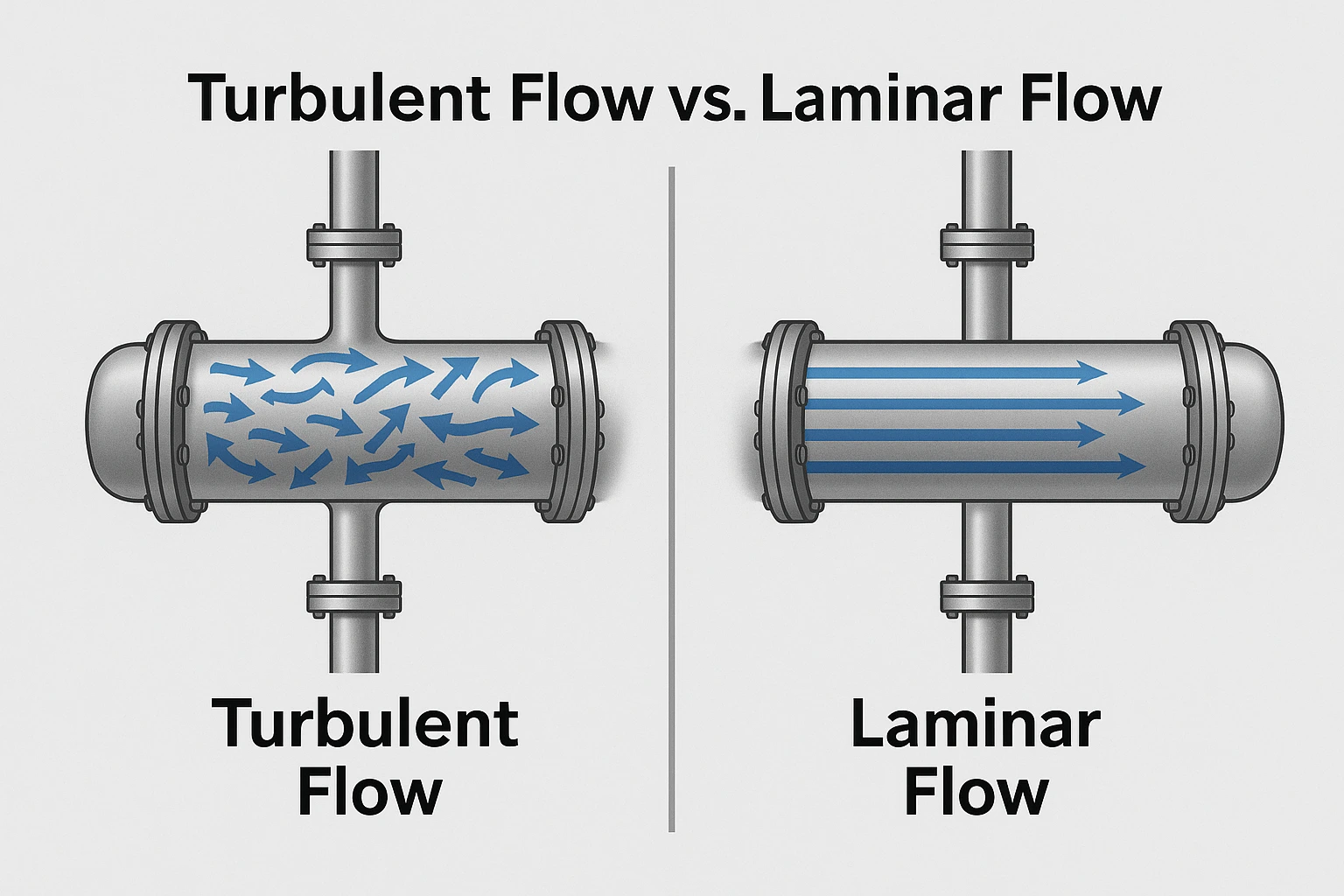
The flow condition is commonly evaluated using the Reynolds Number, which considers:
- Fluid velocity
- Pipe inside diameter
- Fluid density
- Dynamic Viscosity
Precision Filtration Products designs its High Velocity Oil Flushing Services to achieve turbulent flow with a reynolds number greater than 4,000. PFP then continuously filters the circulating oil until the agreed cleanliness requirements are achieved.
Because oil viscosity influences Reynolds number, flushing oil may be heated under controlled conditions. Lower viscosity makes it possible to achieve the required turbulence without relying solely on an extreme increase in pump flow.
A successful flush therefore depends on more than attaching a large pump. Flow rate, temperature, viscosity, pipe diameter, filter capacity, and temporary loop design must work together.
The Pre-Commissioning Oil Flushing Process
Every industrial system requires a project-specific flushing plan. Pipe size, fluid properties, system volume, cleanliness requirements, and component sensitivity can all affect the design.
A typical pre-commissioning flushing project includes the following stages.
1. Establish the required cleanliness target
The project team should define the acceptance criteria before flushing begins.
The target may come from:
- The equipment manufacturer
- Project specifications
- The system owner
- Component-cleanliness requirements
- An engineering or commissioning standard
ISO 4406:2021 provides the coding method used to describe the level of solid-particle contamination in hydraulic fluids. It does not establish one universal cleanliness target for every system.w
ISO 12669 provides a method for determining the required cleanliness level based on the needs of the individual hydraulic or lubrication system.
That distinction matters. A cleanliness code suitable for one gearbox may be inadequate for a system containing sensitive servo controls.
2. Review the system layout
The flushing provider evaluates the piping and determines how oil must be routed through the system.
The review may include:
- Pipe sizes
- Total fluid volume
- Branch lines
- Reservoir configuration
- Coolers and heat exchangers
- Available connection points
- Flow restrictions
- Sensitive components
- Sampling locations
Piping and instrumentation diagrams are especially valuable during this stage.
The objective is to ensure that adequate flow reaches each section requiring cleaning. A high overall pump flow does not guarantee sufficient velocity through every individual branch.
3. Isolate or bypass sensitive components
Bearings, control valves, pumps, and other sensitive components may need to be bypassed during the initial flush.
Temporary hoses, spool pieces, jumper lines, and manifolds can be installed to create dedicated flushing loops. These temporary connections allow contamination to be removed without passing heavy debris through equipment the process is intended to protect.
Large or complicated systems may need to be divided into multiple flushing circuits. Each loop can then be cleaned under controlled flow conditions.
4. Install the temporary flushing equipment
The equipment package may include:
- High-flow pumps
- Heater skids
- Particulate filter vessels
- Temporary reservoirs
- Hoses and manifolds
- Flow meters
- Pressure instrumentation
- Particle counters
- Sampling equipment
The filtration system must be sized for the anticipated flow and contamination load.
Coarse and fine filtration stages may be used to prevent large debris from prematurely loading the final filter elements. Parker recommends that filling and flushing filters be larger and finer than the filters installed on the machine itself, and notes that cascading filtration from coarse to fine can extend filter life.
5. Condition the oil and establish turbulent flow
The oil is circulated and heated to the planned flushing temperature.
As viscosity decreases, the flushing equipment increases the flow rate until the required flow condition is achieved. Flow must be confirmed through the actual flushing circuit rather than assumed from the pump’s maximum rating.
The system may be flushed using:
- Flow-rate changes
- Temperature cycling
- Reversed flow
- Individual branch flushing
- Controlled pipe vibration
- Mechanical agitation where appropriate
These methods help disturb contamination that may remain in low-flow areas.
6. Capture the released contamination
Once debris is mobilized, it must be removed before the oil returns to the system.
Temporary high-capacity filter vessels capture solids while differential pressure is monitored across the elements. A heavily contaminated system may require frequent filter changes during the early stages of the flush.
As the system becomes cleaner, filter loading should generally slow and particle-count results should begin to stabilize.
7. Monitor and verify cleanliness
The flush should not end simply because a predetermined number of hours has passed.
Cleanliness can be evaluated using:
- Online particle counting
- Bottle sampling
- Patch testing
- Screen inspection
- Filter-element inspection
- Laboratory analysis
Samples should be collected from representative locations and under stable operating conditions.
A single acceptable sample may not prove that every flushing loop has reached the target. Results should be reviewed for consistency before the system is accepted.
8. Document the final results
A complete flushing report provides evidence that the process met the project requirements.
Documentation may include:
- Flow rates
- Oil temperature
- Reynolds number
- Filter changes
- Sample locations
- Particle-count results
- Final ISO cleanliness code
- Project observations
- Recommended follow-up actions
Once the system is accepted, temporary equipment can be removed and bypassed components can be returned to their normal configuration.
When Should Pre-Commissioning Oil Flushing Services be Scheduled?
A pre-commission flush should occur late enough that fabrication and installation work will not immediately recontaminate the system. It must also occur early enough to prevent commissioning delays.
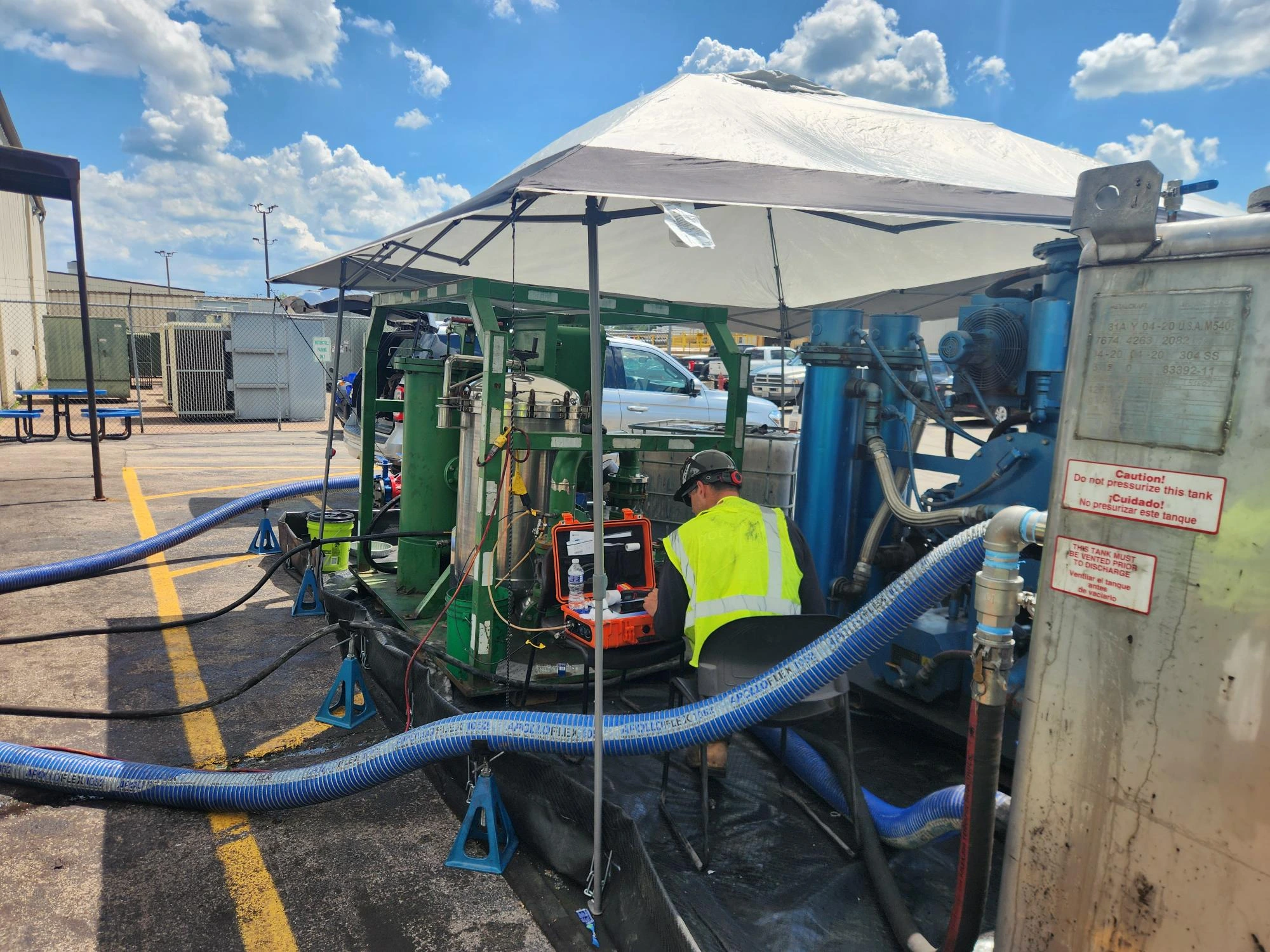
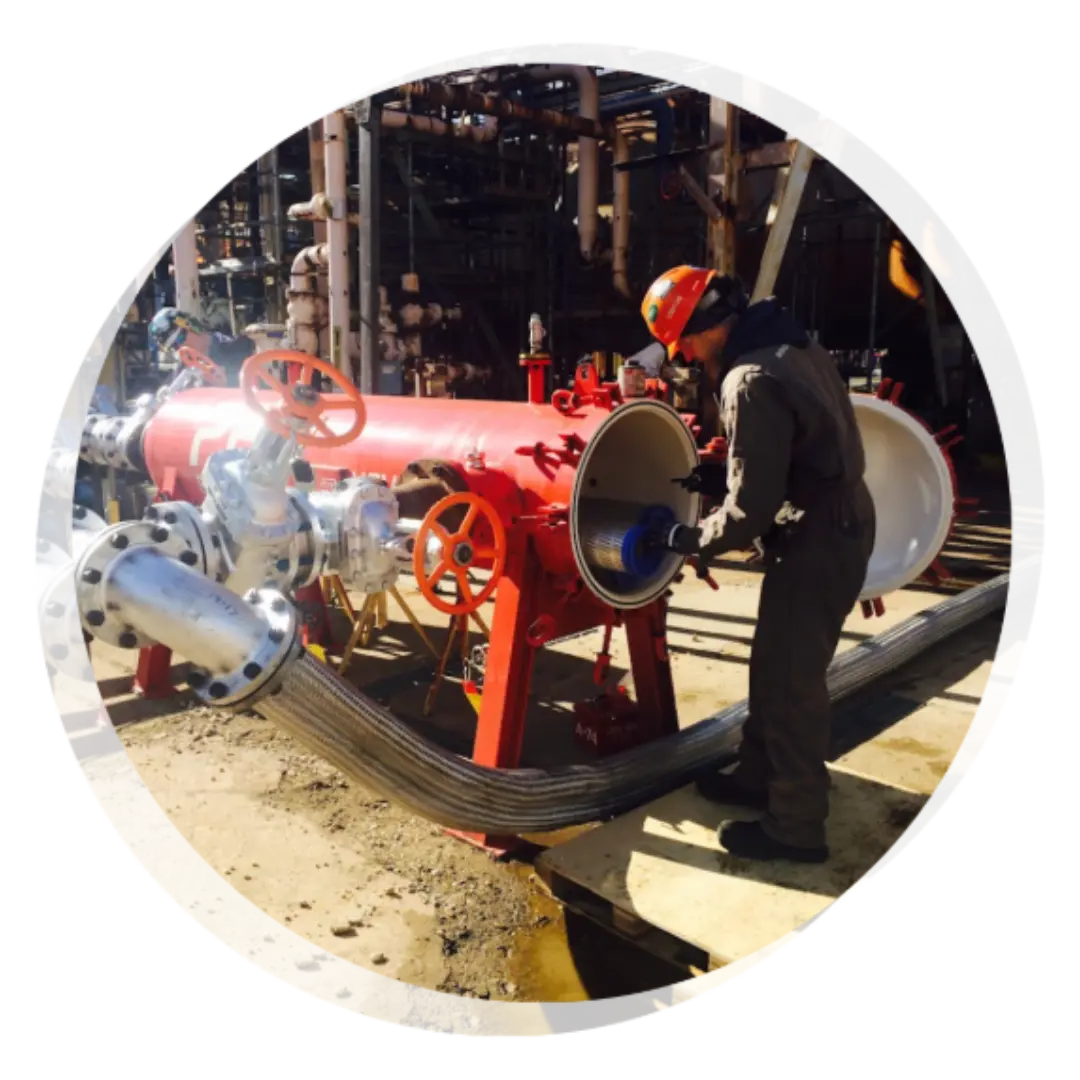
PFP Service Crew Performs High-Velocity Oil Flushing Service
Flushing should generally be coordinated after:
- Major pipe fabrication is complete
- Reservoirs have been cleaned
- System openings have been closed
- Required temporary connections are available
- Heavy construction work around the system has ended
- The flushing oil and target cleanliness code have been approved
Planning should begin well before the proposed startup date.
Waiting until the final stage of commissioning can create problems with equipment availability, connection design, hose routing, electrical requirements, and project staffing.
Parker’s hydraulic-maintenance guidance plainly recommends flushing systems before their initial startup.
How Long Does a Pre-Commissioning Oil Flush Take?
There is no fixed flushing duration that applies to every project. The total length of the procedure depends entirely a variety of factors, including:
- System size
- Pipe configuration
- Initial contamination level
- Flushing flow rate
- Fluid viscosity
- Filter capacity
- Number of temporary loops
- Required cleanliness target
A flush is considered complete when the approved acceptance criteria have been satisfied (not merely when the equipment has operated fora certain number of hours).
That is why cleanliness monitoring is an essential aspect of pre-commissioning flushing projects. Without measured results, there is no reliable way to confirm that the system is ready for startup.
What Information Does an Oil Flushing Provider Need?
Providing accurate project information is non-negotiable for a successful pre-commission flush project. This information will aid in selecting the proper equipment and reducing delay.
Essential information typically includes, but is not limited to:
- System fluid and viscosity
- Total system volume
- Pipe sizes
- Noral operating flow
- Available connection points
- Piping drawings
- Required cleanliness code
- Site utilities
- Proposed startup date
- Known contamination concerns
- Need for on-site personnel
The provider is also required to know whether the project is a new installation, system rebuild, oil conversion, or cleanup after maintenance to account for all relevant factors.
Turnkey Pre-Commissioning Oil Flushing From PFP
Precision Filtration Products provides turnkey industrial high-velocity oil flushing services for hydraulic systems, turbine lubrication systems, compressors, process piping, and other critical circuits.
PFP can support the complete flushing process with:
- System assessment and project planning
- Temporary flushing-loop configuration
- High-flow pumps and heater skids
- High-capacity filter vessels/housings
- Hoses and auxiliary equipment
- On-site technicians
- Real-time particle monitoring
- Final cleanliness reporting
PFP’s flushing and filtration fleet supports flow rates ranging from 1 GPM to 6,000 GPM. Systems are configured around the fluid, piping arrangement, contamination level, and required cleanliness target rather than forcing every project into one standard setup.
Facilities with qualified in-house personnel can also obtain rental filtration equipment, including high-velocity flushing skids, heaters, and particle-monitoring equipment. PFP provides on-site setup, operation, reporting, and breakdown when additional field support is required.
For immediate pre-commission flushing support, call (888) 679-6645.
Our expert specialists are always available to discuss your unique flushing project requirements. To learn more, call or submit a form on contact page.