
When a plant schedules a system flushing project, the expectation is simple: clean the system so it runs the way it’s supposed to. The issue is that most contamination doesn’t float freely in the oil. It collects on the pipe walls, heat exchangers, pumps, manifolds, and every low-flow pocket that has slowly built-up debris over the years.
This is why the flow regime inside the system determines how successful the flushing job will be.
What Is Laminar Flow?

Laminar flow is when fluid moves in smooth, orderly layers with very little mixing. The velocity at the center of the pipe is highest, and it drops off significantly near the pipe wall. That slow-moving boundary layer is the main reason laminar flow does very little druing a flushing operation.
What Is Turbulent Flow?

Turbulent flow behaves differently. The fluid moves with enough velocity to break the boundary layer and mix across the entire pipe diameter. The motion becomes chaotic, and that energy physically lifts contamination from the surfaces and carries it into the flow stream.
How Flow Behavior Impacts System Flushing
During any oil, fuel, or high-flow flushing operation, the goal is to remove contamination that normal filtration cannot reach. Filters only clean what enters the flow path. If the flow is calm, most of the debris never moves. It remains stuck to the walls and waits for the system to return to service.
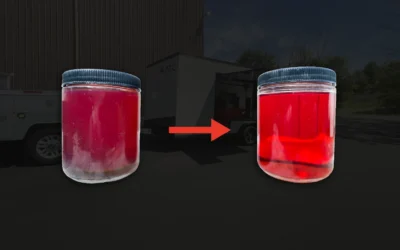
Laminar flow works fine during steady-state operation, but not for system cleaning. The boundary layer stays intact, so the surfaces never see enough force to release the build-up. This is why a laminar flush can show improved ISO codes during the project, but immediately spike again once the system starts up. The oil was cleaned. The system wasn’t.
Why Turbulent Flow Makes Oil Flushing Effective
Turbulent flow collapses the boundary layer and provides the shear needed to lift contamination from internal surfaces. Once the debris is suspended in the oil, a flushing skid can filter it out. Without that mechanical action, even the finest filters won’t reach what’s bonded to the system walls.
Oil flushing standards can point to the Reynolds number as the indicator. The threshold is usually around 4,000 mineral oils, depending on the viscosity and pipe diameter. High-velocity flushing systems are designed to exceed this so that the flow stays solidly in the turbulent range throughout the loop.
How PFP Supports Turbulent Flushing Projects
PFP understands the urgency behind system flushing projects.
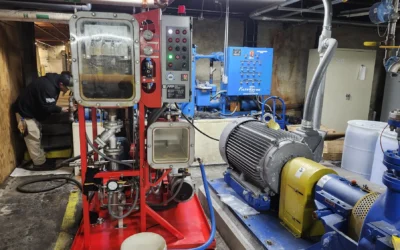
We provide high-velocity oil flushing equipment ready for rapid mobilization and backed by technicians with decades of experience in turbulent flushing. Our focus is straightforward: clean the system thoroughly so it returns to service in a stable, reliable condition. The goal is to help the plant avoid repeat contamination issues, support
Looking for reliable high velocity oil flushing services?
If you’re looking for support on a flushing project, look no further. Contact us today to discuss your project requirements with one of our expert filtration specialists!